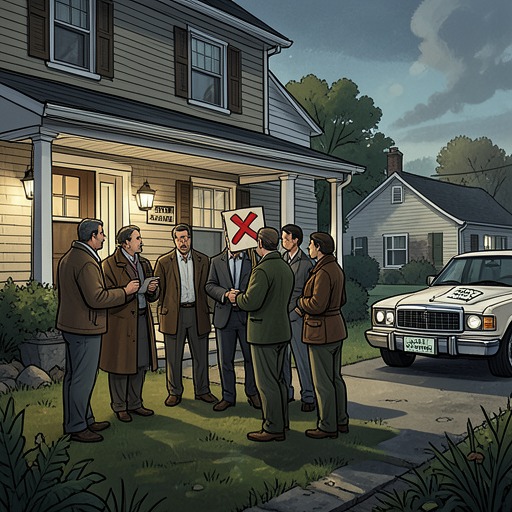
Motor-vehicle prohibition in the residential area
A Man Called OveThe Motor-vehicle prohibition in the residential area is a posted restriction on driving into the Residential Area, and Ove treats its plain wording as decisive. He invokes it against officials and neighbors alike, then carries its logic into a moment when an ambulance is needed. The rule’s importance lies not only in keeping vehicles out: it gives Ove a concrete standard to defend, while exposing how his fidelity to procedure can collide with the urgent needs of the people around him.
The sign and the rule
The prohibition is established through a sign that Ove points to as clear and unambiguous. When challenged over a trailer, he directs attention down the road to the notice that motor vehicles are prohibited inside the Residential Area. His argument is not that he personally dislikes a particular driver; he insists that the stated restriction applies, and that the sign is the relevant authority. The exchange makes the rule visible as an everyday feature of neighborhood life: it governs movement through shared space and offers residents a standard they can cite when someone tries to bring a vehicle in.
The rule also operates amid broader conflicts between residents and public officials. Ove’s house once stood on the boundary between two municipal authorities, a circumstance that complicated the fire brigade’s response when a fire spread from a neighbor’s house to his own. The man in the white shirt then invoked permissions and procedures before the fire brigade could act. That episode is not an application of the vehicle prohibition, but it sharpens the distinction between Ove’s own understanding of a rule and the administrative use of rules by officials. He distrusts procedures that obstruct necessary action; the posted traffic restriction, by contrast, is one he regards as clear and worth enforcing.
Ove enforces the boundary
Ove’s insistence becomes especially direct when a man in a white shirt arrives in a car near Anita and Rune’s house. Ove calls out before he reaches him, telling him not to drive farther into the Residential Area. The official answers that he has permission. Ove does not accept that assertion as a reason to disregard the sign, and the confrontation makes the disputed boundary tangible: one man claims an exception, while Ove appeals to the rule as written.
The dispute continues when a trailer becomes the focus of an argument. Ove is told to move it and threatened with a call to the police. He points again to the sign prohibiting motor vehicles inside the Residential Area, treating it as an answer to the demand rather than as a minor technicality. His dry explanation that there was nothing good on television presents him as someone who has chosen to stand outside and enforce the neighborhood restriction. The humor does not make the rule less serious to him; it shows how readily he turns routine vigilance into a public challenge.
His opposition to the official is not limited to vehicle access. Ove contacts Social Services to argue against placing Rune in a care home, and the responsible officer turns out to be the same man in the white shirt. Ove has already antagonized him over the car, and their telephone conversation deteriorates into insults before they address Rune’s situation. Ove objects to the prospect of removing someone from home because his memory has weakened. The collision between these disputes reveals why the traffic rule matters to his larger resistance: it is one visible point at which he can confront an official whose authority he otherwise experiences as remote and difficult to challenge.
An emergency tests the principle
The prohibition’s sharpest test comes after Ove chases burglars and suffers a severe heart attack. As he collapses in the snow, he hears Parvaneh nearby and thinks that he must make her promise not to let the ambulance drive between the houses. The restriction remains active in his mind even as his own life is in immediate danger. The juxtaposition is both comic and serious: a rule usually applied to neighborhood traffic becomes part of his final thought before he loses consciousness.
When Ove wakes in hospital, he asks Parvaneh whether she let the emergency vehicle enter the Residential Area. His concern is not merely an abstract defense of the sign; he expects the rule to hold even when it would be convenient, or perhaps necessary, to set it aside for him. The episode gives the prohibition a personal cost. Ove’s characteristic insistence on consistency reaches into an emergency that requires other people to care for him, and his concern about the vehicle persists alongside his recovery.
Routine, care, and contradiction
Four days later, Parvaneh and Patrick support Ove as he walks through the snow toward his house. Ove has recently refused to let Parvaneh back a car between the houses, and she protests that she already understands his warning about the restriction. Even after his hospitalization, the rule returns to their everyday exchanges. Its recurrence shows that Ove’s observance is not confined to confrontations with officials: it is part of the routine he tries to maintain with his neighbors, including people close enough to help him home.
That routine carries a tension the story does not resolve by simply declaring Ove right or wrong. He opposes officials when he believes their procedures disregard people’s homes and needs; he also insists on a posted restriction when an exception might serve his own immediate interests. The same stubbornness can make him a defender of shared neighborhood order and an uncompromising rule-enforcer. By placing the sign in scenes of disputes, bureaucratic conflict, and medical crisis, the narrative turns an ordinary traffic prohibition into a measure of Ove’s character: he expects a rule to mean what it says, even when the circumstances make that expectation difficult for himself and others.